
Pregnancy Can Turn Deadly Before Prenatal Care Begins
LDI Fellow and OB-GYN Calls for Faster Testing and Better Early-Pregnancy Care
News
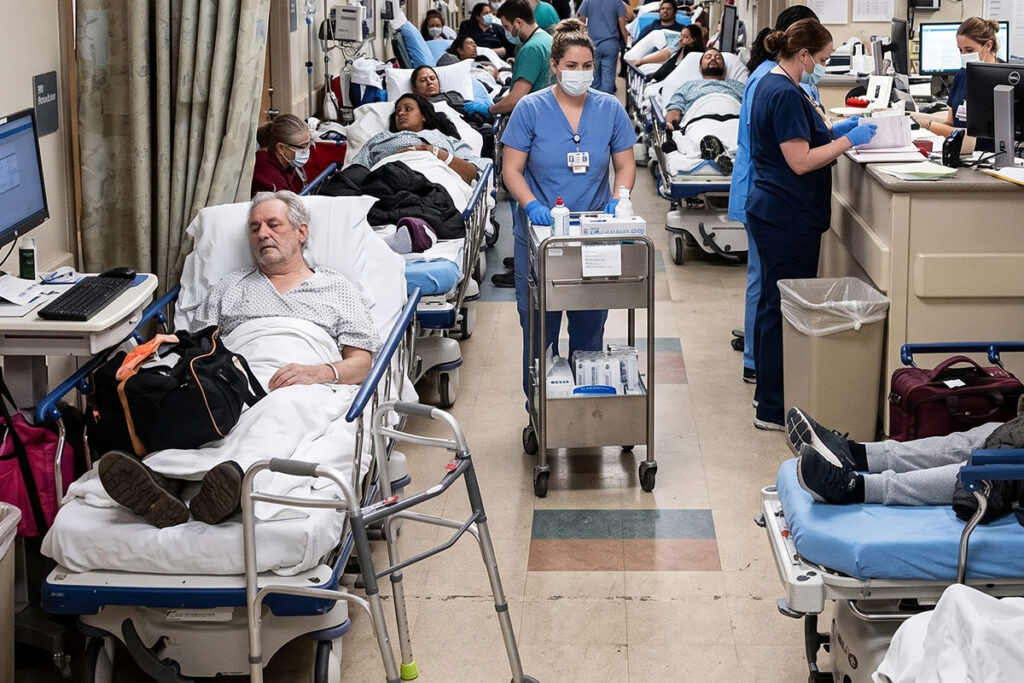
A new study co-authored by LDI Senior Fellow Ari Friedman, MD, PhD, and 36 other emergency medicine researchers, found that thousands of patients who had already been admitted to hospitals remained in a kind of emergency department limbo rather than transitioning to inpatient management for 4, 12, 24, or more hours — and were often subject to delays in inpatient management that “may contribute to patient harm.”
The study, which appears to be the first multi health system investigation focusing on a little-recognized aspect of boarding delay, was titled “Time to Inpatient Management for Boarding Emergency Department Patients” and published online in JAMA on Aug. 17, 2026.

Friedman is an Assistant Professor of Emergency Medicine at the University of Pennsylvania, holds a secondary appointment in the Department of Medical Ethics and Health Policy, and is Director and Core Faculty at the Center for Emergency Care Policy and Research.
“Boarding” in a hospital emergency department refers to patients who have been seen by a clinician and officially admitted to the hospital but, because there are no inpatient beds available in the general medicine wards, are kept in the ED, often on gurneys crowded into corridors.
A 2023 Joint Commission Journal on Quality and Patient Safety paper noted, “ED boarding has been associated with delayed and missed care, medication errors, delirium, higher morbidity and in-hospital mortality, worse patient experience and satisfaction scores, and longer hospital length of stay.”
Boarding is one of three different periods of delay patients can experience in a hospital’s admission process. The first happens in the ED waiting room while waiting to be seen by a clinician. The second occurs after a clinician concludes that the patient needs to be admitted for further treatment, but no inpatient team is available to manage the patient. The third delay occurs when there are no staffed inpatient beds available, and a patient is kept — or boarded — somewhere in the ED for hours before going to a staffed hospital room.
But the transition to inpatient medical care does not necessarily wait until the patient reaches that room. Most hospitals deploy inpatient teams to care for patients while they are still boarding in the ED. The new study focuses on how long patients wait after the decision to admit them before inpatient management begins.
This delay in transitioning a boarded patient from emergency to inpatient management is not widely recognized as the patient safety problem that it is, according to the authors.
Their study analyzed more than 3.2 million emergency department visits at 56 hospitals in 17 health systems between June 2024 and May 2025. Nearly 492,000 patients were admitted to general medical services, and more than half of those patients — 53.6% — spent at least four hours boarding in the emergency department while waiting for an inpatient bed.
The researchers also found another little-recognized delay within the boarding process. Among patients admitted to general medical services:
• 84,936 patients, or 17.3%, went at least four hours without being transitioned to care by inpatient medical teams.
• 22,905, or 4.7%, waited at least 12 hours.
• 4,497, or 0.9%, waited at least 24 hours.
A separate editorial co-authored by Friedman and LDI Senior Fellow Kit Delgado in the Annals of Emergency Medicine in June explained how such transitional delays in required medical care can affect admitted patients: “An emergency physician orders antibiotics for a patient with sepsis. They are not given until 10 hours later. Because of the delay, the patient progresses to septic shock and is admitted to the ICU on pressors. Even a single such event is considered unacceptable; multiple safety campaigns exist to prevent it. However, a new analysis published in this issue of Annals of Emergency Medicine more precisely quantifies the harms of a similar phenomenon which occurs every day in US emergency departments (EDs). Admission is ordered by the emergency care team and is not delivered in a timely fashion, and harm results.”
Long delays were more common at academic hospitals, larger hospitals, and hospitals serving greater proportions of Medicaid patients. Older patients, Medicare beneficiaries, and patients arriving with more serious conditions also experienced prolonged delays more often.
In their paper’s discussion, the researchers note that the “latent safety risk” of the third type of delay” is not captured by current quality measures. Despite the critical role of inpatient teams in addressing boarding, the initiation of inpatient management often lagged far beyond the admission decision.”
“The impact of delayed inpatient management care may contribute to patient harm independent of boarding duration,” they continued. “New patient safety measures that pair accountability for timely relocation of patients from the ED to inpatient care may incentivize timely inpatient admission and resource the teams responsible for them.”
LDI Fellow and OB-GYN Calls for Faster Testing and Better Early-Pregnancy Care

Why a 2020 Federal Price Transparency Initiative has yet to Produce a Consumer Shopping Revolution

Cash Incentives Doubled Quit Rates Among High-Risk Patients, Penn LDI Study Finds

Penn Study Finds Fewer Fatal Overdoses on Blocks Where Vacant Buildings were Sealed

AI May Be a Scalable Way to Educate Transplant Patients, but its Clinical Impact Remains Unclear

A Sweetened-Drink Tax May Raise Revenue Statewide While Improving Health