
Pregnancy Can Turn Deadly Before Prenatal Care Begins
LDI Fellow and OB-GYN Calls for Faster Testing and Better Early-Pregnancy Care
News
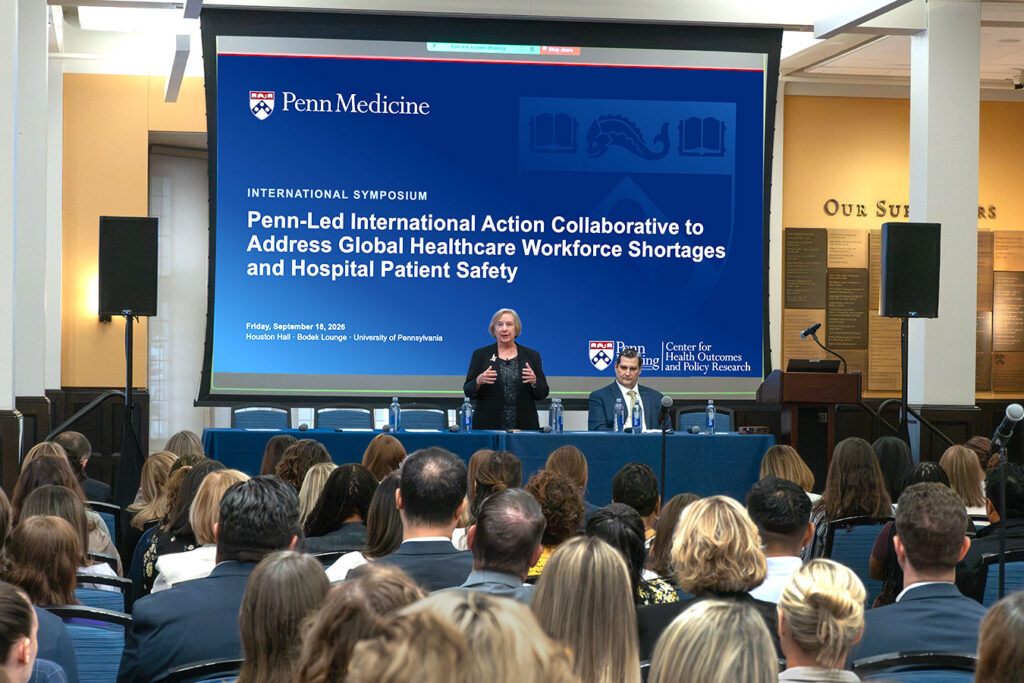
The worldwide nursing shortage cannot be solved simply by educating more nurses or recruiting them from other countries, health care leaders said at a Sept. 18 University of Pennsylvania symposium. Hospitals around the world must also change the working conditions that are causing nurses and other clinicians to burn out and leave.
That message framed the International Action Collaborative to Address Global Healthcare Workforce Shortages and Hospital Patient Safety Symposium, where Penn researchers and nursing leaders reported encouraging results from Magnet4Europe, an initiative that paired 65 European hospitals with 65 Magnet-designated U.S. hospitals.
The University of Pennsylvania’s international focus on the nursing profession began 30 years ago at the School of Nursing’s Center for Health Outcomes and Policy Research (CHOPR), where studies led by LDI Senior Fellow Linda Aiken, PhD, RN, examined nursing practices, working conditions, and patient outcomes in hospitals across more than 30 countries.

Six years ago, those international efforts expanded further when CHOPR became an anchor institution in the EU-funded Magnet4Europe program and Aiken became the project’s co-director. The initiative “twins” or “pairs” U.S. hospitals that have achieved Magnet designation with European hospitals. The U.S. hospitals serve as mentors, helping their European counterparts adopt evidence-based nursing practices and organizational changes modeled on the Magnet framework.
This International Symposium on the Penn campus was designed to look back at the achievements, challenges, and ongoing operations of that Magnate4Europe program and its hospital partners.
The 26-year-old Magnet Recognition Program, run by the American Nurses Credentialing Center (ANCC), designates hospitals that demonstrate excellence in nursing practice and patient care. It evaluates organizations on leadership, nurse empowerment, professional practice, innovation, and measurable outcomes. Magnet hospitals are linked to higher nurse satisfaction, lower turnover, and better patient outcomes.
The European hospitals have been adapting the principles of the Magnet Recognition Program which emphasizes strong nursing leadership, frontline participation in decision-making, evidence-based practice, professional development, and measurable patient outcomes.
The project treats the workforce shortage and patient safety as parts of the same problem: When clinicians work in poorly staffed environments where they have little influence, insufficient support, and limited opportunity to grow, burnout and turnover rise—and patient care suffers.

“Simply producing more nurses is not going to solve this problem,” said LDI Senior Fellow Matthew McHugh, PhD, RN, Director of Penn Nursing’s CHOPR and a Penn leader of Magnet4Europe. Unless hospitals address the problems pushing nurses from bedside care, he said, increasing the supply can fail to produce a stable workforce.
At the start of the project, researchers surveyed nearly 10,000 nurses and physicians working in participating European hospitals. About one-quarter were experiencing burnout, and one in three intended to leave their workplace because of concerns about the work environment, McHugh reported.
After four years, the average participating hospital had closed about half the gap between its practices and Magnet standards—progress that McHugh said would ordinarily take about a decade. Hospitals in the top quarter for implementing the Magnet principles recorded approximately 25% improvements in burnout, clinicians’ intention to leave, safety, and quality of care.
The benefits extended beyond nurses, he said. Improvements in nurse staffing and nurse-physician teamwork were associated with lower intentions to leave among physicians, reinforcing the symposium’s broader contention that a good nursing environment strengthens the entire clinical workforce.
Aiken, said that research pointed toward Magnet as the most evidence-based intervention ready for a large international test.
“The global shortage of health care workers is because we don’t retain the ones that we already trained,” Aiken said, citing the World Health Organization’s emphasis on retention.
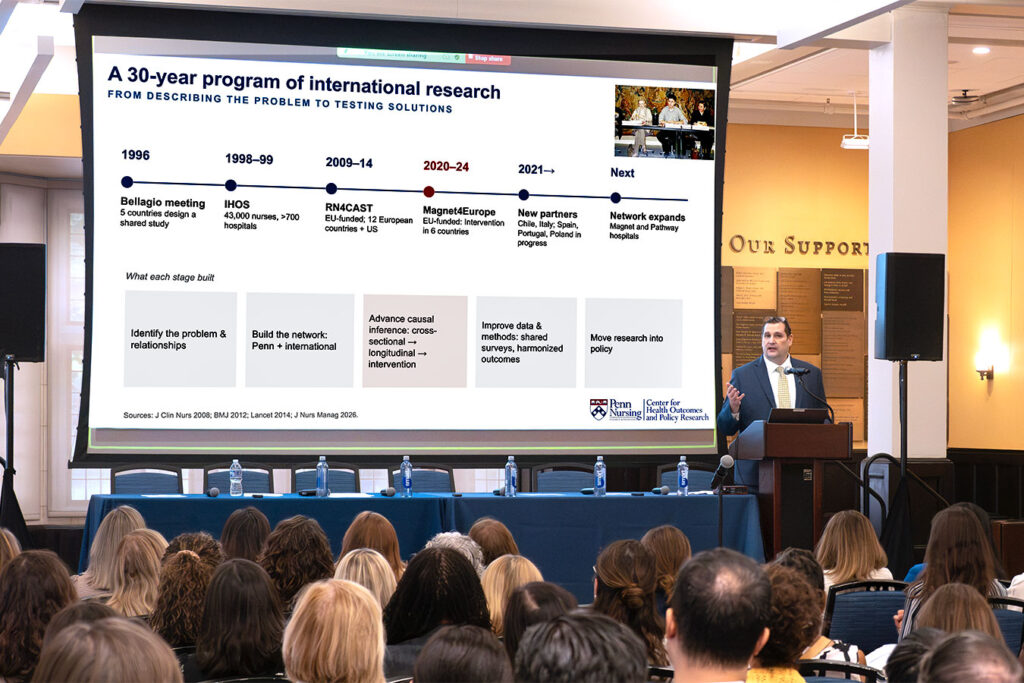
She described Magnet4Europe as an unusually large action collaborative spanning 130 hospitals that survived the COVID-19 pandemic without a hospital withdrawing and has continued beyond its original EU grant funding. Penn leaders said the network is now expanding into additional countries, with related work underway in Australia.
The heart of the initiative is “twinning”: European hospitals work directly with experienced U.S. Magnet hospitals through monthly learning sessions, site visits, and practical collaboration. Rather than exporting an inflexible American template, the partners adapt Magnet principles to different education systems, professional roles, regulations, financing structures, and hospital cultures.
In one panel of the symposium, Penn Medicine nurses described how those collaborations have changed daily practice.
The Hospital of the University of Pennsylvania has helped University Hospital Münster in Germany develop a nursing strategic plan, a professional practice model, a transition-to-practice program for new nurses, and the outcome benchmarking required for Magnet review. Münster has also created forums where nurses share successful improvements across units and plans to submit its Magnet application in 2028.
Penn Presbyterian Medical Center and Pennsylvania Hospital worked with University Hospital Regensburg in Germany to establish a mentoring program in evidence-based practice. Because most German nurses enter through vocational rather than bachelor’s-level education, a growing group of bachelor’s-prepared nurses has been trained to help colleagues turn bedside observations into clinical questions and evidence-based changes.

Penn Medicine Lancaster General’s partnership with Dessau Medical Center in Germany introduced unit “huddle boards” displaying measures such as patient falls and pressure injuries. Frontline nurses could see their results and discuss how to improve them. Angela Robinson, MSN, RN, Lancaster General’s Magnet Program Manager, said the German hospital subsequently recorded visible reductions in both measures. Its experience also demonstrated the importance of leadership: simultaneous turnover in its chief executive and chief nursing positions temporarily slowed the work before a new nursing leader rebuilt momentum.
Penn Medicine Princeton Health and El Camino Health in California have worked with two Belgian hospitals, AZ Sint-Maarten and RZ Heilig Hart Leuven, on nursing strategic planning, shared governance, staff engagement, and standardized definitions of nursing quality measures. Their discussions have expanded to problems common on both sides of the Atlantic, including crowded emergency departments, hospital capacity, length of stay, artificial intelligence, and new categories of nursing licensure.
The partnerships are not one-way technical assistance, speakers emphasized. U.S. hospitals have also learned from their European counterparts, and the international exchange has prompted U.S. clinicians to reconsider assumptions embedded in their own systems.
LDI Senior Fellow Antonia Villarruel, PhD, RN, Dean of the University of Pennsylvania School of Nursing, said Magnet recognizes more than nurses’ individual work. It reflects “the environment in which nurses can work and thrive.”
Penn Medicine CEO and LDI Senior Fellow Kevin Mahoney similarly described Magnet as a measure of teamwork across an institution. As care grows more complex and clinicians confront workplace violence, political polarization, and new technology, he said, evidence—not intuition alone—must guide decisions about staffing, operations, and patient care.

International Council of Nurses CEO Howard Catton placed the project against a far larger global shortfall. Although the number of nurses worldwide has grown to roughly 30 million, he said, international estimates of unmet need vary dramatically depending on the level of care countries aim to provide. He also warned that some health systems may respond by substituting workers with shorter training instead of investing in registered nurses and better professional environments.

“We shouldn’t be thinking of recruitment and retention as two separate things,” Catton said. Poor working conditions not only drive nurses away, he noted, but also make the profession less attractive to potential recruits.
The symposium also confronted the ethics of wealthy countries recruiting nurses from nations with fewer health care resources. Selena Gilles, DNP, FAAN, Associate Dean at Penn Nursing and a TruMerit board member, said professional mobility must be accompanied by accountability for how internationally educated nurses are recruited, employed, supported, and treated.

Catton called for “co-investment,” under which recruiting countries and institutions would return a proportionate benefit by supporting nursing schools, faculty, or health systems in the countries supplying workers. Without such investment, he said, recruitment can deepen shortages and dependency in lower-income nations.
David Stewart, RN, MHN, Director of Nursing Policy and Practice at the International Council of Nurses, tied the discussion back to patient safety. Major investigations of health system failures in several countries have repeatedly identified the same underlying problems, he said: inadequate staffing, poor organizational culture, weak governance, and the exclusion of nurses and physicians from decisions.
For Penn’s leaders, Magnet4Europe offers evidence that those conditions are not immutable. Hospitals can retain clinicians and improve patient care by building environments where nurses are heard, supported, recognized, and equipped to translate frontline experience into institutional change.
The emerging lesson is that the nursing shortage is not solely a shortage of trained people. It is also a shortage of workplaces capable of keeping them.

LDI Fellow and OB-GYN Calls for Faster Testing and Better Early-Pregnancy Care

Why a 2020 Federal Price Transparency Initiative has yet to Produce a Consumer Shopping Revolution

Cash Incentives Doubled Quit Rates Among High-Risk Patients, Penn LDI Study Finds

Penn Study Finds Fewer Fatal Overdoses on Blocks Where Vacant Buildings were Sealed

AI May Be a Scalable Way to Educate Transplant Patients, but its Clinical Impact Remains Unclear

New Study Focuses on Boarding Transition Time to Inpatient Medical Care