
U.S. Smokers Face a Maze of Conflicting Nicotine Risk Messages
Doctors Must Explain How Switching From Cigarettes May Lower Health Risks
Blog Post

Lung cancer screening (LCS) reduces deaths by at least 20% among older adults with a heavy smoking history. Half of people who undergo screening still smoke, so supporting them in quitting can further reduce tobacco-related deaths.
However, people eligible for LCS have often smoked for decades. In this group, said LDI Senior Fellow Joanna Hart, “smoking is very ingrained in their lives.”
Insurers, including Medicare and Medicaid, require that tobacco-cessation resources be offered to patients undergoing LCS, but health care organizations are uncertain which strategies are most cost-effective. They may refer patients to quitlines, provide free nicotine-replacement therapy (NRT), such as patches or gum, or prescribe medications that reduce nicotine’s effects. They may offer intensive — and expensive — behavioral counseling.
The Healthy Lungs study by Hart and LDI Senior Fellows Rachel Kohn, Kevin Volpp, Dylan Small, Alisa Stephens-Shields, Scott Halpern, and colleagues took an innovative approach to identifying the most effective smoking-cessation interventions for people undergoing LCS: The randomized controlled trial focused on groups who have less access to smoking-cessation assistance and were underrepresented in earlier studies, including rural residents, those living in poverty, or people who identify as Black, African American, or Hispanic. In contrast to many previous studies, Healthy Lungs enrolled people regardless of expressed interest in quitting. It is also the first to test financial incentives — paying people to quit — among people referred for LCS.
Based on the results and earlier studies, Halpern said, “Cash payments for quitting are highly cost effective — if not cost saving.”
As a pragmatic trial, Healthy Lungs was integrated into routine care, allowing health systems to incorporate successful elements into clinical workflows. A stakeholder group that included patients, community advocates, and government and health leaders guided study design and shaped participants’ experience.
The study included 3,228 participants across four health systems in Pennsylvania, Michigan, and Southern California. Nearly all were older than 50, consistent with LCS guidelines. All had a clinician’s LCS order, smoked combustible (non-vaping) tobacco daily, and belonged to one or more of the following groups: Black or Hispanic people, rural residents, people whose highest level of education was a high school degree, or people with low incomes. Participants were not initially told that the study focused on smoking cessation, helping ensure a range of interest in quitting.
Participants were randomly assigned into four groups with additive interventions:
Participants set a quit date and completed online surveys at two weeks, three months, and six months to report whether they were smoke-free. Those who reported quitting were tested for nicotine byproducts. Participants were paid for completing the surveys and tests.
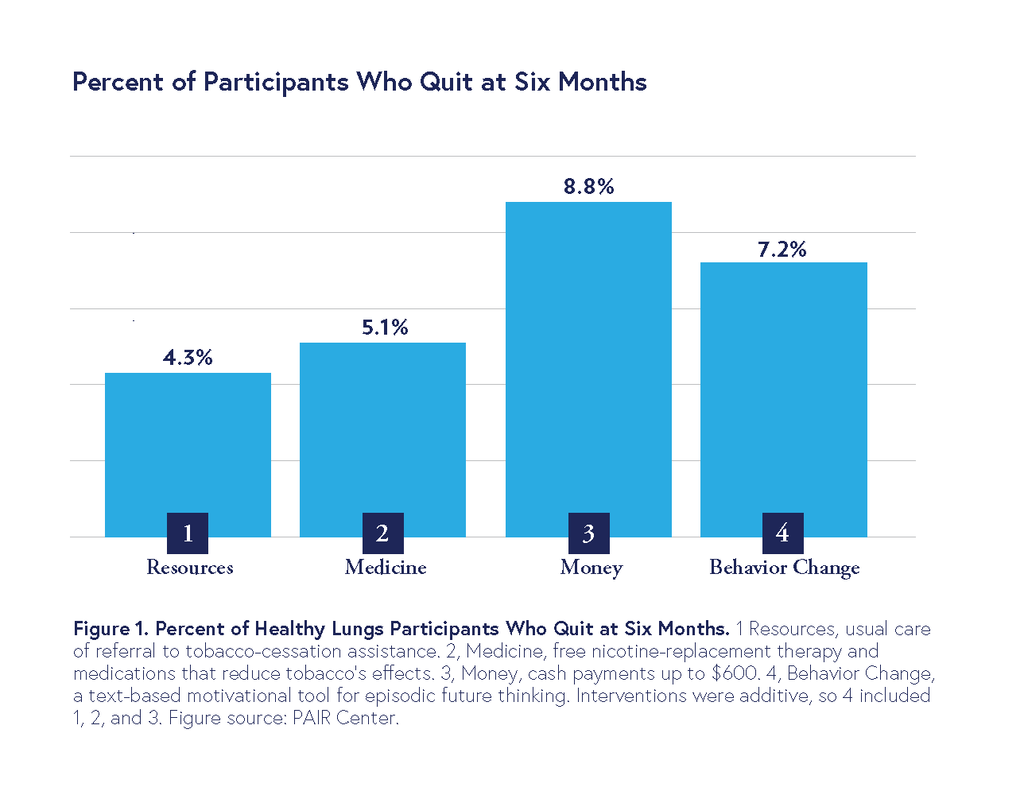
Sustained tobacco abstinence through six months was 4.3% in Group 1 with usual care, 5.1% in Group 2 with added pharmacotherapy, 8.8% in Group 3 with added financial incentives, and 7.2% in Group 4 with added motivational tools (Figure 1).
”The clear message,” Hart said, “is that financial incentives, when added to advice about resources like quitlines, and free pharmacotherapy, doubled the rate of sustained tobacco abstinence in this very hard-to-reach population.”
Long-term abstinence at 12 months was not measured, but generally, about 10% of those who quit return to smoking after 12 months. The researchers could not analyze participants’ experiences because not enough completed surveys on personal motivation and quitting barriers.
Nonetheless, Hart said, “What we did worked.”
Healthy Lungs adds new, highly pragmatic evidence for supporting smoking-cessation treatment at the time of LCS, complementing studies showing that paying for quitting works in employer-sponsored programs with younger and predominantly white participants.
In Healthy Lungs, no sociodemographic characteristics predicted response to interventions, so results likely apply to people getting LCS, regardless of geographic location, rural or urban residence, race, ethnicity, education, income, or interest in quitting.
The financial incentives intervention, Halpern said, is “100% ready” for clinical implementation based on the Healthy Lungs results and pragmatic design.
The research team is advising health systems on how to implement pay-to-quit programs and hopes to investigate implementation barriers. A critical question is: Who pays incentives? Candidates include groups that financially benefit from a healthier population including health care organizations, insurers, and employers.
The researchers also hope to study the most effective payment amounts and distribution methods for avoiding tobacco long-term. Communication around cash for quitting is also crucial, Hart said. Although everyone benefits through healthier air and possible lower health care and insurance costs, individuals who do not smoke might question the fairness of paying others to quit.
The bottom line is that cash incentives have a more direct connection to tobacco cessation than quitlines, free pharmacotherapy, or motivational counseling, Hart said. “It’s paying people to quit, rather than paying for the process of treatment.”
The study, “Smoking Cessation Among Underserved Patients Referred for Lung Cancer Screening: A Randomized Clinical Trial,” was published on October 5, 2026 in Journal of the American Medical Association. Authors include Joanna L. Hart, Anil Vachani, Christine M. Neslund-Dudas, Michael K. Gould, Matthew A. Facktor, Shira Blady, Brian A. Bayes, Dorothy Sheu, Vanessa L. Madden, Emma Britez Ferrante, Nirali Patel, Jenny Tian, Casey Whitman, Beth Creekmur, Rachel Kohn, Michael J. Simoff, Kevin G. Volpp, Dylan Small, Michael E. Scott, Amanda L. Holm, Alisa J. Stephens-Shields, and Scott D. Halpern.
Research reported in this blog was funded through a Patient-Centered Outcomes Research Institute® (PCORI®) Award (PCS-2018C1-11326). The statements presented in this blog are solely the responsibility of the authors and do not necessarily represent the views of the PCORI®.

Doctors Must Explain How Switching From Cigarettes May Lower Health Risks

LDI Fellows’ Study Backs Hospital Addiction Care Model, Although Financial Gains Remain Unproven

Chart of the Day: U.S. Misses Heat Deaths That Occur Outside Work, LDI Fellows Say

New Study Finds Many Local Markets Could Support More Competing Hospitals

Two Health Policy Experts Find Bipartisan Consensus in Site Neutral Payments, Controlling Medicare Costs

Leaves May Decay Doctors’ Skills, so Hospitals Need a Plan for Reentry, LDI Expert Says