
From Secret Health Care Prices to Too Much Information
Why a 2020 Federal Price Transparency Initiative has yet to Produce a Consumer Shopping Revolution
Health Care Payment and Financing
In Their Own Words

Cross-posted with permission from Health Affairs Forefront.
[Original Post: Eric T. Roberts, Kenton J. Johnston, Karen E. Joynt Maddox, Rachel M. Werner, Allison M. Nishi, José F. Figueroa. “Designing Bilateral Medicare-Medicaid Risk Contracts In The New ACO LEAD Model”, Health Affairs Forefront, September 2, 2026. https://www.healthaffairs.org/do/10.1377/forefront.20260825.541220, Copyright © 2026 Health Affairs by Project HOPE – The People-to-People Health Foundation, Inc.]
Dual-eligible beneficiaries account for a disproportionate share of Medicare and Medicaid spending owing to their complex medical, behavioral, and social needs. Care for this population presents multiple challenges, in part, because Medicare and Medicaid are distinct programs with conflicting incentives for managing costs, which can result in unintended cost shifting across programs, poor care coordination, and potentially avoidable use.
To address these challenges, policy makers have sought to expand integrated care programs, in which financially at-risk entities (such as managed care plans) coordinate Medicare and Medicaid services, and in some cases, manage costs in both programs. Currently, the predominant model for delivering integrated care is through Medicare Advantage Dual-Eligible Special Needs Plans (D-SNPs), which operate under varying levels of financial integration and accountability.
In 2025, 46 percent of dual-eligible beneficiaries with full Medicaid were enrolled in traditional Medicare. Medicare accountable care organization (ACO) models, in which provider groups take risk for attributed beneficiaries’ Medicare-funded medical costs, served 30 percent of dual-eligible beneficiaries with traditional Medicare in 2025. Yet Medicare ACOs historically have lacked an architecture for financial integration with Medicaid.
Through its new ACO Long-Term Enhanced Design (LEAD) model, the Centers for Medicare and Medicaid Services (CMS) and the Center for Medicare and Medicaid Innovation are developing an integrated Medicare-Medicaid ACO model for dual-eligible beneficiaries enrolled in traditional Medicare. As part of this effort, policy makers are devising a framework for bilateral Medicare-Medicaid risk contracts, which CMS plans to test in partnership with two states (to be identified at a future date). This model represents a significant step toward reducing longstanding fragmentation in financing and care delivery for full-benefit dual-eligible beneficiaries with traditional Medicare. However, achieving these goals will be challenging because policy makers have limited evidence to guide key design decisions regarding accountability and risk sharing across Medicare and Medicaid.
In this Forefront article, we highlight several considerations for CMS and state Medicaid agencies regarding the proposed integrated Medicare-Medicaid component of the ACO LEAD model: developing spending benchmarks, improving risk adjustment, appropriately calculating shared savings and losses across programs, and ensuring interoperable data availability.
A central design challenge for LEAD will be establishing Medicaid spending benchmarks. Benchmarks determine the level of spending against which savings or losses are measured, making them critical for both program sustainability and provider participation. The ACO LEAD request for applications outlines how Medicare spending benchmarks will be set; however, Medicaid benchmarks will largely be negotiated between CMS and participating states. A focal point of these negotiations will be benchmarks for Medicaid-funded long-term services and supports (LTSS), which include both institutional nursing home care and home- and community-based services (HCBS); together, these services account for 79 percent of Medicaid spending among dual-eligible beneficiaries. Several factors will be important to guide Medicaid benchmark design.
First, allowing for a state-specific approach to benchmark setting will be critical. States differ in various aspects of Medicaid LTSS coverage, including HCBS waivers, as well as Medicaid eligibility rules for older adult and disabled populations. These factors shape characteristics of states’ dual-eligible populations and Medicaid LTSS spending, making a one-size-fits-all benchmark inappropriate.
Second, benchmarks should aim for stable and predictable Medicaid LTSS spending targets. If benchmarks are set too low, providers may be unwilling to participate because they have little chance to generate shared savings. If benchmarks are too generous, Medicare and Medicaid could end up paying more than necessary without improving care, which may lead to unsustainable spending growth. CMS should also allow benchmarks to adjust for changes over time in factors outside clinicians’ control, such as workforce shortages, rising labor costs, or systemwide shocks such as public health emergencies. For example, CMS built such flexibility into the Achieving Healthcare Efficiency through Accountable Design (AHEAD) total-cost-of-care model, which Maryland was the first state to implement. At the same time, benchmarks should not be routinely lowered simply because an ACO has generated savings. Continually ratcheting down spending targets reduces the financial return from improving care and may discourage organizations from remaining in the model.
Third, how states approach Medicaid benchmark setting will depend on their experience with Medicaid managed care. Twenty-five states currently operate Medicaid managed LTSS programs (MLTSS), in which managed care organizations receive capitated payments to provide LTSS. States often establish separate capitation rates (or rate cells) for different subpopulations, such those with LTSS needs. A common feature of rate cells is a blended, “site neutral” payment for LTSS in nursing homes or for HCBS, which creates an incentive to shift care toward less expensive HCBS where possible. Because this incentive aligns with the goals of Medicare-Medicaid integration policy, MLTSS rates could serve as a starting point for setting Medicaid benchmarks in LEAD.
On the other hand, states without MLTSS programs that instead deliver LTSS through a fee-for-service system will need alternative approaches to setting benchmarks. For example, if a state chooses to implement LEAD only for a subset of its dual-eligible beneficiaries (such as within selected provider groups or regions), one option is to derive benchmarks from Medicaid spending among comparable beneficiaries not attributed to ACOs, thereby indexing the spending target to a counterfactual (spending that would have been expected without an ACO). A second option is to construct benchmarks using methods similar to MLTSS rate setting. Under either approach, benchmarks should be risk adjusted to account for differences in the health and long-term needs of beneficiaries attributed to LEAD ACOs.
Appropriate risk adjustment will be critical to the success of LEAD. Risk adjustment helps ensure provider organizations are paid based on the expected needs of the beneficiaries they serve, reducing incentives and payment distortions that may lead to avoidance of sicker, costlier patient populations. In MLTSS, the use of rate cells for different subpopulations represents a coarse form of risk adjustment. Although rate cells can serve as a starting point for Medicaid benchmarks, policy makers may wish to address limitations of this approach.
Specifically, rate cell methodologies often use a sparse number of cells that have large payment differences between them. This can create undesirable incentives, such as upcoding individuals near the border between cells, as small differences in documented risk can generate large payment increases. Additionally, having discrete rate cells may result in insufficient resources being directed to groups approaching but not yet meeting the threshold for LTSS, which might benefit from proactive targeting of Medicaid-funded services to prevent further functional decline.
States and CMS could address these limitations by developing methods that allow for more graded payment adjustments aligned with expected needs. For example, benchmarks could combine existing rate cells with continuous risk adjustment to better capture variation within beneficiary groups while avoiding large payment cliffs between categories. Additionally, policy makers should prioritize risk-adjustment methods that rely on measures less susceptible to payment-driven coding intensity, such as functional assessments from beneficiary surveys, and pair them with complementary safeguards, such as risk corridors and reinsurance, to limit incentives for favorable selection.
Integrated care programs for dual-eligible beneficiaries, including ACO LEAD, aim to incentivize efficient care delivery while preventing unintended cost shifting between Medicare and Medicaid. How LEAD calculates shared savings and losses will be central to achieving both goals.
First, a shared savings methodology must evaluate whether net savings are realized across both programs. This approach ensures that ACOs do not receive bonuses when spending reductions in one program are more than offset by increases in another.
Second, policy makers should design ACO LEAD to allow state Medicaid agencies to participate in Medicare shared savings (conditional on realizing net savings). This can address a current limitation of D-SNP models, which do not include a mechanism for Medicaid to share in Medicare savings. Importantly, evidence suggests that Medicaid HCBS may substitute for certain Medicare-funded services (such as home health care), reduce Medicare-paid hospitalizations, and support Medicare-paid postacute care in home-based settings rather than higher-cost skilled nursing facilities. This evidence provides a conceptual justification for sharing a portion of Medicare savings with Medicaid.
To illustrate how shared savings might be structured, we first examined hypothetical scenarios, all with net savings. In exhibit 1, we illustrate four possible cases: Scenarios A–C, in which savings are realized within Medicare, but Medicaid savings or losses vary, and Scenario D, in which savings are realized in Medicaid, but losses occur in Medicare.
| Scenario | Hypothetical Risk-Adjusted Realized Medicare Spending (Per Beneficiary Per Month) | Hypothetical Risk-Adjusted Realized Medicaid Spending (Per Beneficiary Per Month) | Realized Medicare Spending − Medicare Benchmark | Realized Medicaid Spending − Medicaid Benchmark | Combined Savings: (Realized Medicare + Medicaid Spending) − (Medicare + Medicaid Benchmarks) |
| A | $2,000 | $1,100 | -$200 | $100 | -$300 |
| B | $2,000 | $1,200 | -$200 | $0 | -$200 |
| C | $2,000 | $1,300 | -$200 | +$100 | -$100 |
| D | $2,300 | $1,000 | +$100 | -$200 | -$100 |
Source: Authors’ analyses of the Medicare Payment Advisory Commission (MACPAC) and Medicaid and CHIP Payment and Access Commission (MedPAC) Data Book (December 2025). Notes: Medicare benchmark is assumed at $2,200 per beneficiary per month, and Medicaid benchmark is assumed at $1,200 per beneficiary per month (for illustrative purposes only). Illustrative benchmark amounts are based on annual Medicaid and Medicare spending among dual-eligible beneficiaries, divided by 12, obtained from the MACPAC and MedPAC Data Book (December 2025), exhibit 22. This hypothetical Medicaid benchmark averages over the long-term services and supports (LTSS) and non-LTSS/community populations. Green shading represents a scenario with savings (spending lower than the benchmark); red shading represents a scenario with losses (spending higher than the benchmark); and yellow shading represents a scenario in which spending equals the benchmark.
We then considered how those savings might be shared between ACOs, Medicare, and Medicaid. We modeled an ACO’s shared savings rate (r) as a proportion of net savings across both programs. For example, an r of 50 percent (similar to the proposed LEAD Professional Risk Option) would give ACOs a bonus equal to $150 per beneficiary per month in Scenario A, $100 per beneficiary per month in Scenario B, and $50 per beneficiary per month in Scenarios C and D. Exhibit 2 compares different ways in which the balance of savings (1–r%) might be retained by Medicare or Medicaid.
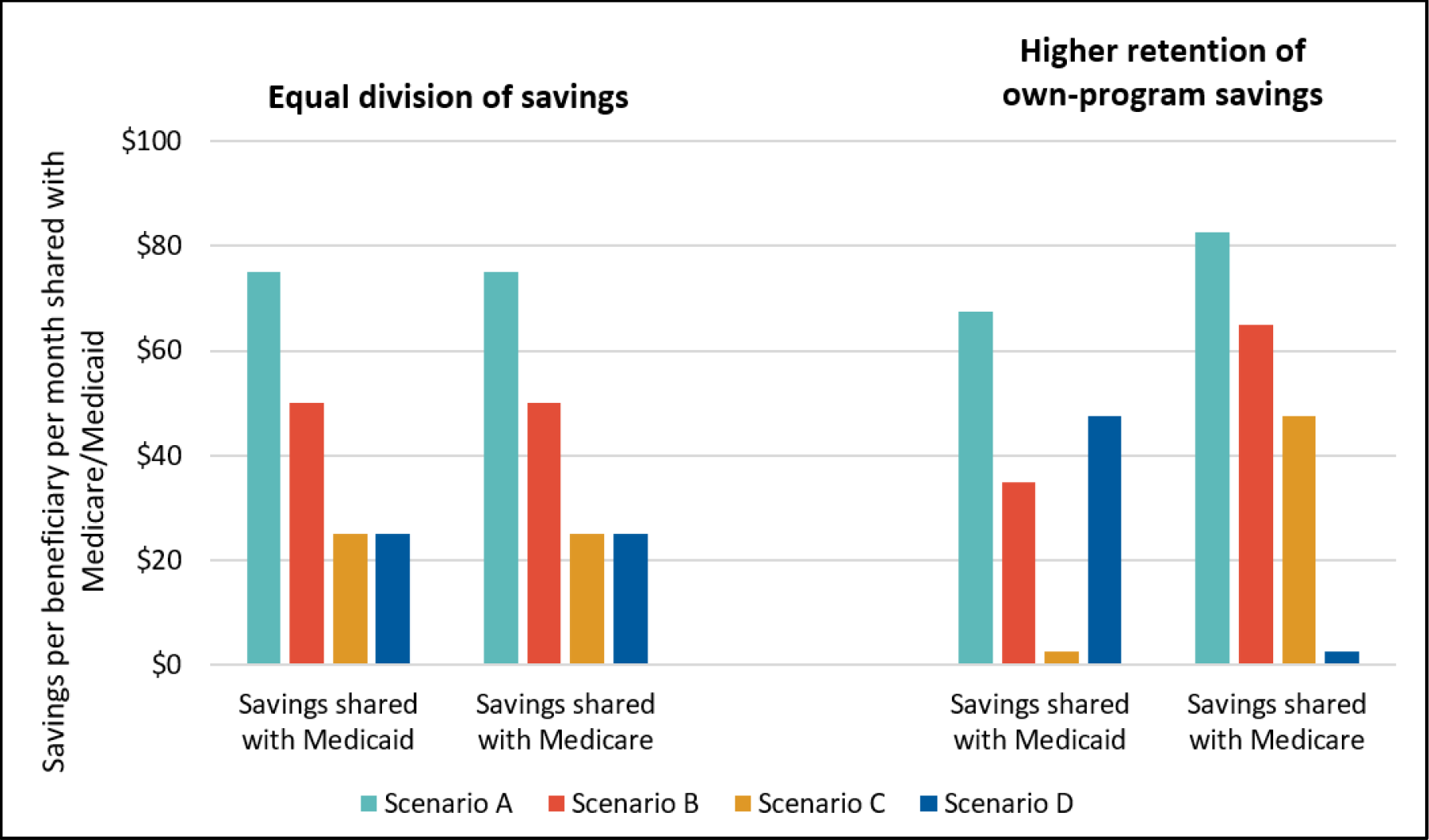
In practice, achieving Medicare savings may require upfront investment in Medicaid-funded services, such as HCBS or behavioral health, as modeled in Scenario B. However, Medicaid savings may be harder to attain in the near to medium term, since those would primarily arise from slowing individuals’ progression to needing higher-cost long-term care (such as nursing home care), and this may take longer to materialize.
CMS could consider structuring shared savings arrangements to account for these cross-payer dynamics and ACOs’ capacity to assume combined Medicare and Medicaid risk. For example, to support appropriate investment in Medicaid-funded HCBS that reduces Medicare costs, CMS could provide ACOs with a higher shared savings rate (r%) and enable state Medicaid agencies to retain a higher proportion of the remainder (1–r%) when higher Medicaid spending is determined to reflect appropriate substitution toward lower-cost, community-based care. In addition, CMS could consider options such as risk corridors or minimum savings guarantees to mitigate early downside risk. These adjustments may be important for attracting and sustaining participation among provider groups with more limited financial reserves or less experience managing cross-program risk.
In addition to these payment considerations, success of ACO LEAD will hinge on interoperable data to support near-real-time tracking of use and spending across Medicare and Medicaid. Such data are critical for dual-eligible populations, whose care often spans acute, postacute, and community-based services financed by different payers. Investments in shared data platforms, standardized attribution files, and aligned reporting across CMS and states will therefore be essential to operationalize accountability under bilateral risk. It will also help to ensure that coordination efforts translate into measurable reductions in avoidable use and total cost of care.
The ACO LEAD model represents a meaningful opportunity to develop and evaluate integrated ACO models that create shared accountability for dual-eligible beneficiaries’ health care use, costs, and outcomes. Careful attention to Medicaid benchmark construction, risk adjustment, shared savings design, and interoperable data infrastructure will be essential to building a sustainable framework with the potential for broader implementation across states and to moving toward systems where dual-eligible beneficiaries’ needs are better met through coordinated, financially integrated care.
The work on which this article is based was partially supported by the SCAN Foundation (Eric T. Roberts, Jose F. Figueroa) and the Laura and John Arnold Foundation (all authors). The funders had no role in the design and conduct of the study; collection, management, analysis, and interpretation of the data; preparation, review, or approval of the article; and decision to submit the article for publication.






Why a 2020 Federal Price Transparency Initiative has yet to Produce a Consumer Shopping Revolution

LDI Virtual Seminar Explores Whether We’re Winning or Losing and What That Means

LDI Expert: Standardize, Digitize Billing to Cut Administrative Costs

LDI Tradeoffs Seminar Examines How Arbitration Rules Are Inflating Payments and Overwhelming the System

Risk-Based Payments May Fail to Lower Low-Value Care, a New Study Shows

These 10 Points Lay Out the Biggest Barriers – From Costs to Complex Rules – and the Reforms Needed to Put More Hospital Care in Homes Nationwide