
Employment Protections for Individuals Experiencing Menstruation, Perimenopause, or Menopause
Testimony: Delivered to Philadelphia City Council’s Committee on Health and Human Services
Policy
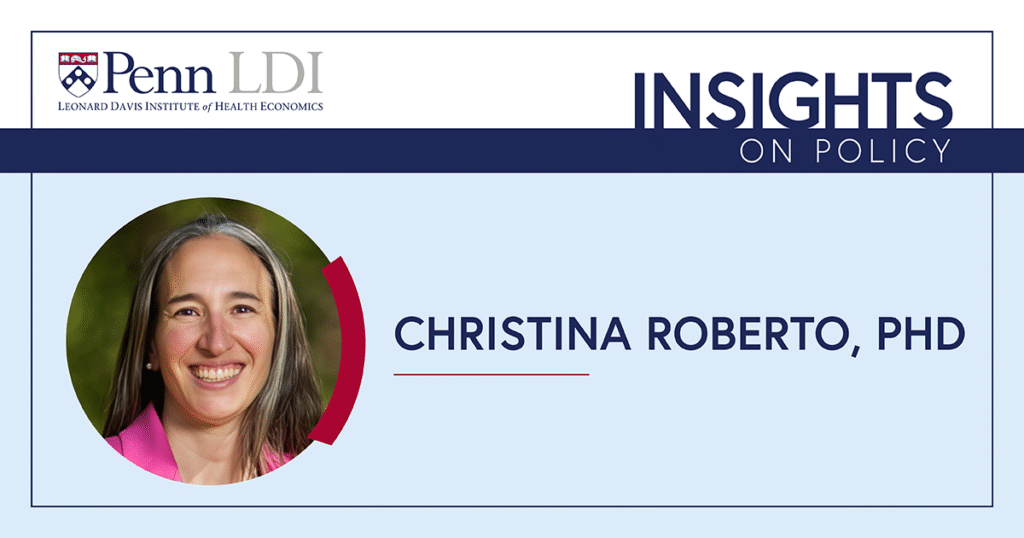
In October 2025, LDI Senior Fellow Christina Roberto, PhD testified before Philadelphia City Council’s Committee on Labor and Civil Service on the topic of Philadelphia’s sugar sweetened beverage tax.
Dr. Roberto’s testimony highlighted the positive health impacts of Philadelphia’s sugar-sweetened beverage tax, noting that the policy has led to reduced sales of taxed beverages at major food retailers, along with improvements in dental health and declines in adult obesity rates.
You can watch Dr. Roberto’s testimony, which begins at 2:02:10, here.
Views expressed by the researchers are their own and do not necessarily represent those of the University of Pennsylvania Health System (Penn Medicine) or the University of Pennsylvania.
Christina A. Roberto, PhD
Mitchell J. Blutt and Margo Krody Blutt Presidential Professor of Health Policy
Director, Center for Food and Nutrition Policy
Senior Fellow, Leonard Davis Institute of Health Economics
University of Pennsylvania
Good morning. My name is Christina Roberto of the University of Pennsylvania. Thank you for the opportunity to provide testimony today regarding Resolution No. 250028 introduced by Councilmember Harrity.
I am a Professor of Health Policy and Fellow at the Leonard Davis Institute who has studied people’s eating habits and food and nutrition policies for 20 years. My testimony today represents my professional views and not those of the University of Pennsylvania or Penn Medicine. Over the last 8 years, I have led multiple studies of the Philadelphia sweetened beverage tax. This research shows that the tax has improved health, particularly for the lowest income Philadelphians. Repealing this tax would be devastating for the City and its residents. There are many positive benefits of the sweetened beverage tax in terms of what it funds in the City, but my brief comments will focus on the benefits I’ve studied directly.
We studied unemployment claim filings in Philadelphia compared to those in other untaxed Pennsylvania counties one year before and after the tax. We saw no change in unemployment claims overall or in industries affected by the tax, such as supermarkets and soda companies.1 University of Illinois researchers reached similar conclusions: Philadelphia employment counts were not lower than a comparison group two and a half years after the tax.2
We found the tax was associated with a 35% reduction in taxed beverage sales at major chain food retailers in Philadelphia when compared to similar retailers in Baltimore.3,4 That drop persisted for two years, even after accounting for some people shopping outside of the city. These beverages, such as soda, are linked with type 2 diabetes, obesity, and tooth decay.
We also published a study showing that the tax reduced soda intake among adolescents.5 In another study, we used data from electronic dental records and found that the tax was associated with a 22% reduction in cavities among adults on Medicaid and 30% among children on Medicaid.6 Similarly, we observed that the tax was associated with reductions in obesity among adults7 though we did not observe effects among children. Studies from seven other U.S. cities with sweetened beverage taxes also find similar improvements in health, including reductions in obesity and gestational diabetes.8,9
Discussions of repeal of the tax are behind the times. Our tax continues to generate revenue for higher-quality education, local employment, and more inviting community spaces. It has done this all while reducing intake of drinks that make us sick. It would be a grave mistake to support its repeal.
References
Testimony: Delivered to Philadelphia City Council’s Committee on Health and Human Services

Comment: Delivered to the National Center for Complementary and Integrative Health
Comment: Submitted to the U.S. Department of Veterans Affairs

Comment: Delivered to the U.S. Department of Labor

Memo: Delivered to the U.S. Food and Drug Administration (FDA)
Letter: Delivered to House Speaker Mike Johnson and Majority Leader John Thune