
AI Device Firms Pay $60M to U.S. Doctors, Raising Oversight Concerns
In a First-of-Its-Kind Analysis, Researchers Track Industry Payments Tied to AI Medical Devices and Call for Stronger FDA Oversight, Transparency, and Aid for Underserved Hospitals
Population Health
News
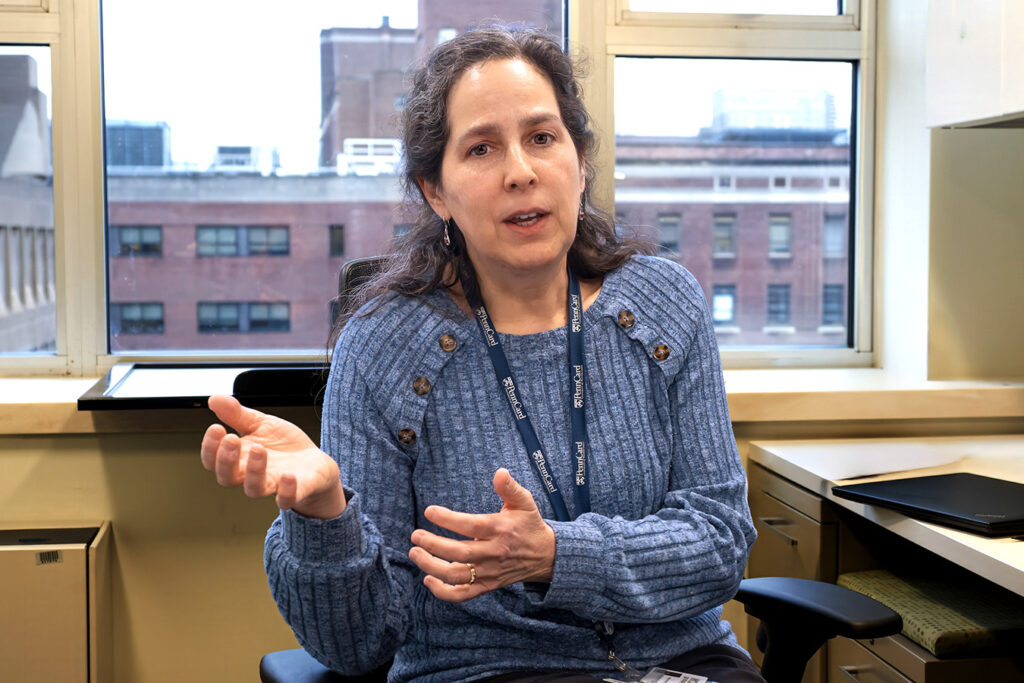
After a three-year stint as Health Commissioner of Philadelphia, Cheryl Bettigole, MD, MPH, has joined the University of Pennsylvania, become an LDI Senior Fellow, and in January was named the new Executive Director of the Penn Center for Public Health (CPH).
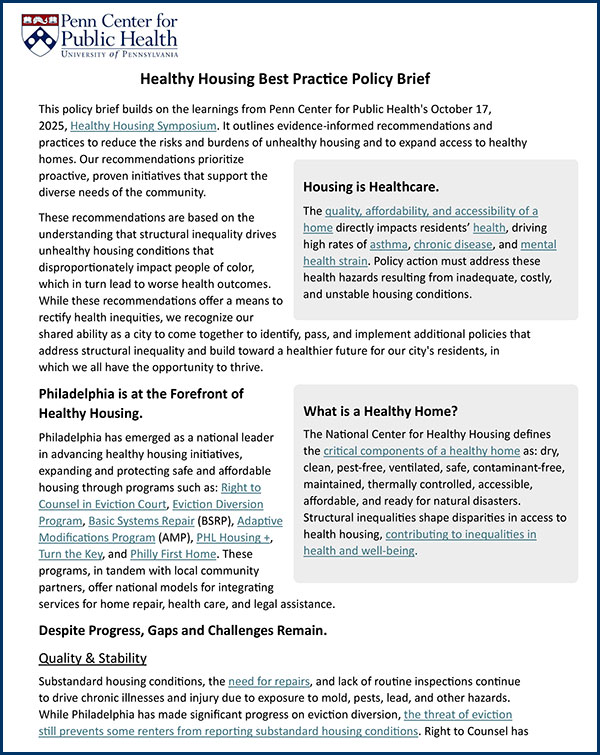
The Center has already published a new policy brief on best practices for healthy housing in Philadelphia as part of an effort to inform City Council’s current deliberations on a proposed legislative package that would strengthen tenant protections and property maintenance standards.
Titled Healthy Housing Best Practice Policy Brief, it positions unhealthy and unaffordable housing as a central, structural driver of health inequities in Philadelphia and calls for coordinated housing, legal, health, and social policy reforms to close gaps that current programs have not fully addressed.
Commenting on the impact of the brief in City Hall, Councilmember Nicolas O’Rourke said, “As a member of Council’s Committees on Public Health and Licenses and Inspections, currently working on landlord-tenant law, Dr. Bettigole’s brief was right on time. The politics of securing universal safe, healthy housing may be murky, but the research showing its necessity is clear. I’m glad to say that Council is now considering some of the brief’s topline solutions, and that our mayor is increasing funding for Licenses and Inspections to begin proactive rental inspections in Philadelphia.”
Established in 2007 by the Penn Provost’s Office, the Penn Center for Public Health was designed to bridge the gap between Penn’s 12 schools and the broader Philadelphia community. It also serves as the academic home for the Master of Public Health (MPH) program and currently has 164 Senior Fellows who are Penn faculty members or director-level staff. Throughout its history, the Center has focused heavily on addressing the social determinants of health and systemic health inequities in the neighborhoods surrounding the campus.
In a related action on March 4, City Council’s Committee on Housing, Neighborhood Development, and the Homeless voted to advance the final two portions of the Council’s Safe Healthy Homes Act for a full Council vote later this month. The measures would create a program requiring proactive City inspections of rental units and expand eviction protections prohibiting landlords from retaliating against tenants who join tenant unions or cooperate with City inspectors.
Philadelphia has approximately 315,000 renter-occupied units, accounting for roughly 48% of the occupied housing stock — making the city unusually renter-heavy compared with other U.S. cities. Public housing is a small subset of that total, with about 13,000 units owned by the Philadelphia Housing Authority (PHA).
Similar to the Council’s proposed legislation, the CPH brief also recommends development of a proactive City rental inspection program to replace the current system that responds only to complaints from tenants. It would require the Licenses and Inspections (L&I) Department to inspect every rental property before a tenant moves in.
Bettigole explained that housing conditions are one of the most powerful drivers of health in cities like Philadelphia. Problems such as mold, leaking roofs, and other structural defects are not simply housing maintenance issues but direct public health hazards.
“In the current system, if someone complains, the city will come out and do an inspection,” said Bettigole, who is a Professor of Clinical Family Medicine & Community Health at the Perelman School of Medicine. “Over the years, I’ve seen my own patients who can’t get out of these really unsafe housing situations because they have to call and complain about the conditions, and then their landlord knows who filed the complaint, so that person is then at risk.”
“It goes like this,” she continued. “I’m a mom of a couple of young kids, and my kids have asthma. The place I’m living in is a wreck. The roof is leaking. There’s mold over in the corner. The kitchen doesn’t work. The toilets don’t work. And I have nowhere else to go. I could stay with my sister, but her landlord doesn’t want more people staying there. So you can tell me to complain to my landlord because that mold is kicking off my child’s asthma. But if I do that and the landlord decides to evict me, then I’m never going to get another place to live.”
“That power dynamic is really critical when we think about healthy housing,” Bettigole said. “In theory, the complaining tenant shouldn’t be evicted, and they should have legal defense against that. But in practice, it doesn’t work that way. They’re terrified, so they don’t complain as their family’s health continues to be negatively impacted by unsafe conditions.”
She pointed to childhood asthma as the clearest example of that connection, noting that more than 20% of Philadelphia children suffer from the disease — about twice the national rate — and that children living in unhealthy housing often cycle through repeated emergency room visits, hospitalizations, and missed school days.
Asthma attacks in rented units are often driven by structural defects such as leaks and cracks that lead to chronic mold growth and pest infestations, including cockroaches and rodents. In poorly ventilated spaces, high concentrations of allergens, dust mites, and secondhand smoke become trapped, causing constant airway inflammation. For low-income families, these indoor triggers are often worsened by proximity to industrial pollution and a lack of resources to force necessary building repairs.
A native of Buffalo and the daughter of a physician, Bettigole earned a BA in history from Yale University and an MA in anthropology from the University of Chicago before her life experiences pushed her in a different direction. Two of those were watching a good friend’s medical procedure balloon into mammoth bills and observing the daily struggles of a co-worker trying to manage the life and health of a child with asthma.
She found herself becoming less enthusiastic about pursuing a PhD in anthropology and began feeling adrift and wanting to do something that mattered more. Ultimately, a late-night discussion with her boyfriend — now her husband — resulted in an epiphanic moment of clarity.
“I decided to go to med school, do underserved community care for about ten years, and then do health policy and figure out how to fix the system,” she said.
That path led her to earn a medical degree from Jefferson Medical College and a Master of Public Health (MPH) from the Johns Hopkins Bloomberg School of Public Health.
One of the themes running through her medical career has been a particular concern about asthma and children.
“I’m in family medicine and have worked in a number of health centers taking care of many children living in poverty,” Bettigole said. “There’s something really visceral about watching a child who can’t breathe. You can watch their ribs suck in, their face twist into a mask and their neck muscles straining as they struggle to inhale. You can’t watch that and know it’s related to the conditions they live in and not feel like you should be doing something about it.”
“Most landlords are not bad actors,” she said. “But how do we actually enforce penalties on the ones who are?”
In City budget hearings last year, Bettigole noted that the rough estimated cost of establishing a citywide proactive rental inspections program was about $6 million annually.
“But,” she said, “there is a cost to what we’re currently doing. Otis Hackney, who used to run the Mayor’s Office of Education, pointed out to me that if an asthmatic child misses 15 days of school per year — a normal occurrence in Philadelphia — that means 15 days a year from kindergarten through 12th grade. That adds up to about a year of missed school.”
“If we want our children to graduate and ideally go on to college, they need to be in school,” she said.
“If you posit where that $6 million a year might lead, you think about one percent of kids being more likely to get their GED or finish high school. The average income for someone who has finished high school or earned a GED is close to $10,000 more than someone who hasn’t. If we look at that in terms of income across the city, we will do far better by spending that $6 million to keep our kids in school and healthy than by not spending it,” Bettigole said.
When asked what the weakest area of research evidence was related to health and housing, Bettigole immediately answered: “mold.”
“You may see a big patch of it on the wall and know that its spores are likely in the air, but there is no established method for measuring the clinical significance or pathogenicity of specific mold exposures,” she said.
“For instance, you can’t get a certification that a home is mold-free. The regulations tend to focus on moisture intrusion, holes in the roof, and that kind of thing. Mold measurement is an area where we need more research because it really matters.”
Looking ahead to the Center for Public Health’s next policy focus, Bettigole pointed to juvenile incarceration and health.
“Incarceration has negative impacts on youth across nearly every aspect of health,” she said. “There is no real benefit to incarcerating children. There are only negatives.”
“If we can keep kids out of jail, it’s only for the better,” she continued. “They do better economically. They do better in terms of their health. They do better in terms of their mental health.”
“Philadelphia has a higher incarceration rate for our youth than most other places,” Bettigole said. “That is improving, but at a slower rate than other places. Our Spring Symposium on Youth Incarceration and Public Health will dig into a better understanding of how these trends might be changed.”
In a First-of-Its-Kind Analysis, Researchers Track Industry Payments Tied to AI Medical Devices and Call for Stronger FDA Oversight, Transparency, and Aid for Underserved Hospitals

Health Insurer Acquisition of PBMs — the Prescription Drug Middlemen — Raised Premiums for Some Part D Beneficiaries

LDI Senior Fellow Honored for International Research Achievements
Memo: Delivered to the Office of Pennsylvania State Senator Maria Collett

First Rural Health Grants May Not Go to Areas With the Greatest Needs, LDI Experts Find
Research Brief: Cash Transfer Programs Improve Birth, Nutrition, and Early Childhood Health Outcomes