
Policy Recommendations for Strengthening the Accelerated Approval Program for Oncology Drugs
Memo: Delivered to the U.S. Food and Drug Administration (FDA)
News
For the second year of what will now be an annual program, the University of Pennsylvania’s Leonard Davis Institute of Health Economics (LDI) is kicking off the 2021-2022 cohort of Amplify@LDI, a dissemination training program designed to assist its Senior Fellows in reaching a wider audience with research and policy insights.
Headed by LDI Director of Engagement Alison Buttenheim, PhD, MBA, the eight-month curriculum brings in working journalists, public relations consultants, social media experts, writing coaches, and veteran policymakers as instructors. The program is designed to increase the visibility of LDI senior fellows and build skills to effectively disseminate research.
“Our first full cohort of Amplify@LDI was excited by how to better engage with the media and policymakers,” said LDI Executive Director Rachel M. Werner, MD, PhD. “It is essential that scientists learn to translate their findings for audiences far beyond academia. That has never been more important than now.”
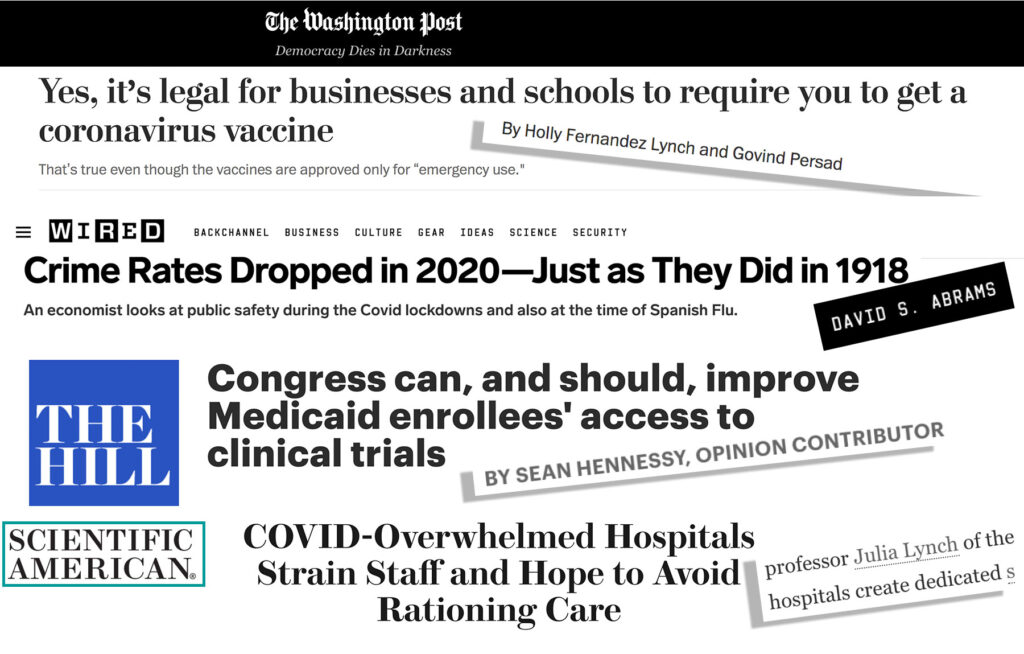
Throughout their training last year, the 2020-21 cohort of 12 LDI Senior Fellows with previously low-levels of mainstream media experience racked up more than two dozen published op-eds, blogs, and interviews in national print, broadcast and digital news outlets. In addition, several of them scored engaging connections with Congressional offices and other government agencies.
The dozen Senior Fellows selected for the new cohort that begins September 10 are from Penn’s Schools of Medicine, Nursing, Arts and Sciences, and the Annenberg School for Communication. They are: Anish Agarwal, MD, MPH, MS; George Demiris, PhD, FACMI; Dalmacio Flores, PhD, ACRN; Christina Kang-Yi, PhD; Iliana Kohler, PhD; Judith Mckenzie, MD, MPH; Jeanmarie Perrone, MD; Shazia Siddique, MD, MSHP; Rebecca Stewart, PhD; Andy Tan, PhD, MPH, MBA, MBBS; Harsha Thirumurthy, PhD; and Emily Vail, MD, MSc.
As digital technologies and social media have come to dominate and accelerate the daily spread of scientific information in recent years, granting agencies like NIH have increasingly required research applications to include specific dissemination plans designed to make the research findings known to broader audiences. These trends and requirements have challenged many academic researchers whose prior formal training did not include such things as how to collaborate with print or broadcast journalists, engage with government policymakers, or author articles in a vernacular suitable for publication in newspapers, magazines and other general circulation national media.
Over the last 11 years, the Leonard Davis Institute of Health Economics (LDI) has evolved as a major center for translational communications for Penn’s health services research community. Tested as a pilot program in 2019, the Amplify@LDI training program became a full-fledged curriculum for Senior Fellows in 2020.

Memo: Delivered to the U.S. Food and Drug Administration (FDA)

A Crisis in Maternal Care is Unfolding—and it’s Hitting Rural and Urban Communities Alike

Stable Payments Improved Margins But Not Liquidity, New LDI Analysis Finds

LDI Senior Fellow Cited for “Significant Contributions” in Research

Outdated Laws Target Black and Queer Lives in Over 30 States, Fueling a Deadly Disease

Selected for Current and Future Research in the Science of Amputee Care
Research Memo: Delivered to House Speaker Mike Johnson and Majority Leader John Thune

Research Memo: Delivered to House Speaker Mike Johnson and Majority Leader John Thune

Hospitals’ Current Cost Reports are Unreliable and Should be Improved, LDI Fellow Finds